
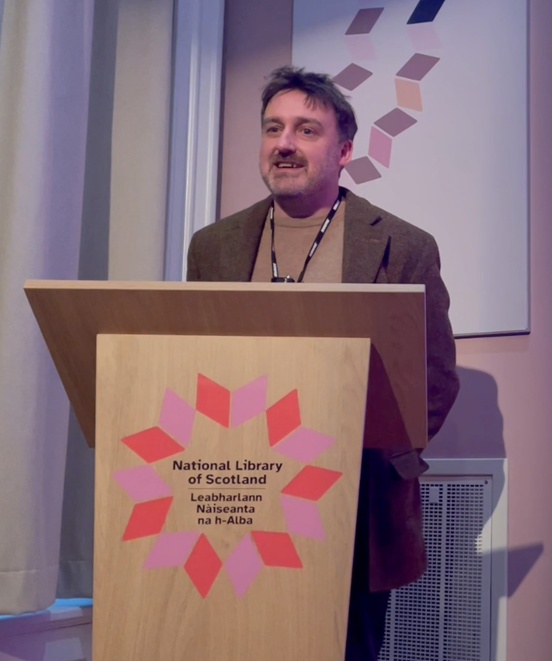
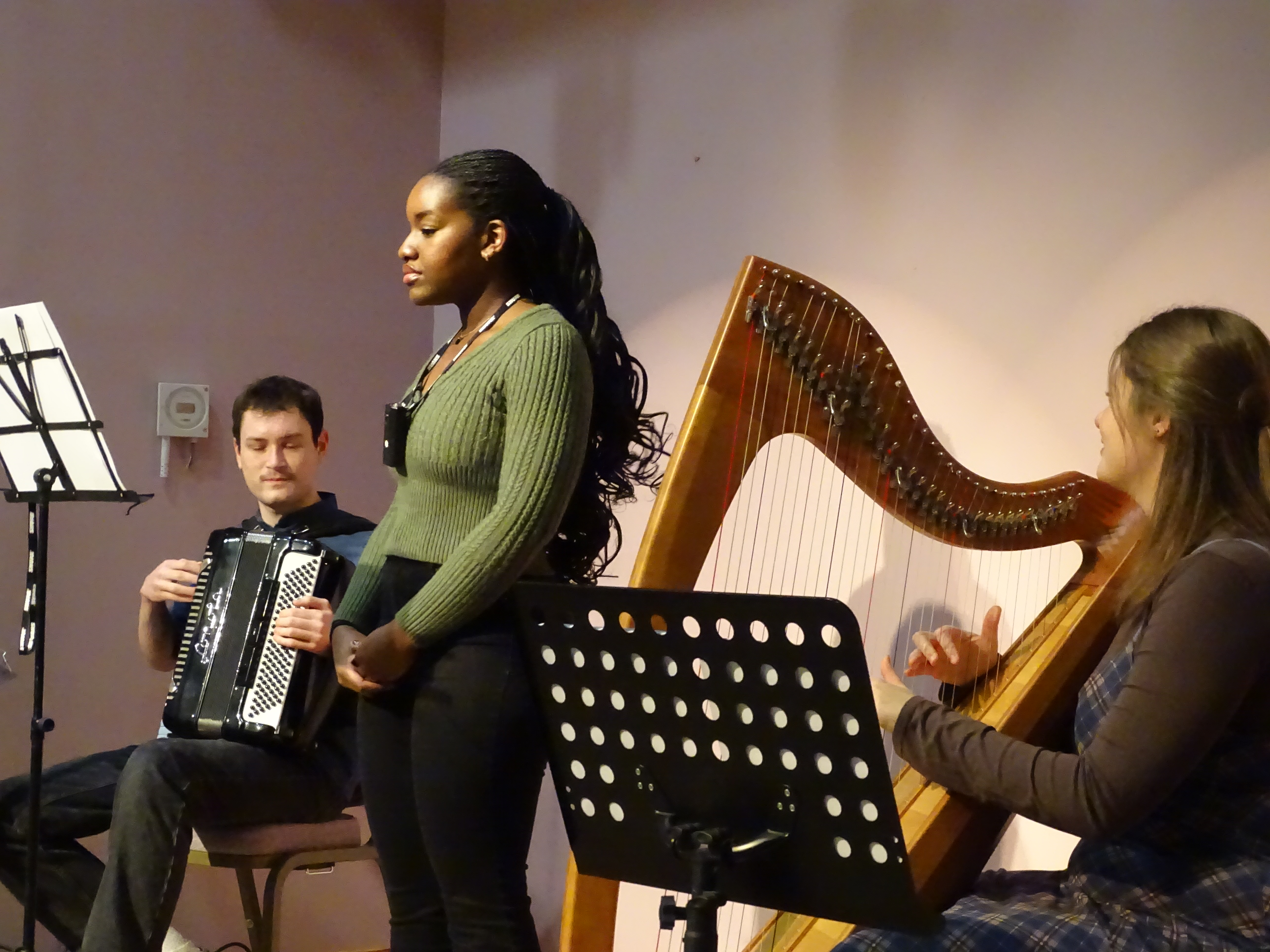
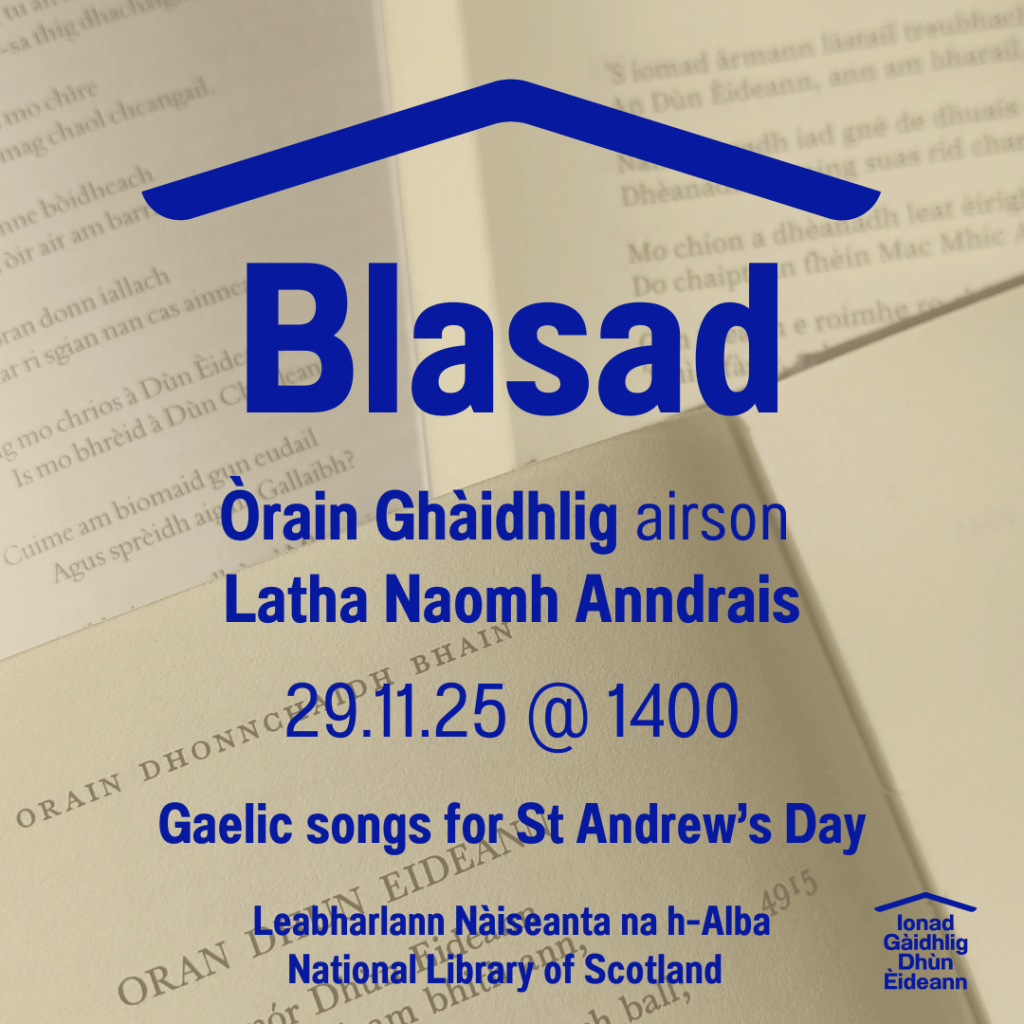
We celebrated St Andrews Day on 29 November in a special concert hosted by the Scottish Makar, Peter Mackay. Nine beautiful songs reflecting different ways in which Edinburgh and the Gaelic world have been intertwined over the centuries were performed by young Edinburgh Gaelic musicians: Laura Penman, Tawana Maramba, Iris MacLeod, Seren Maramba, Oisín Fuentes and Alasdair Scott.
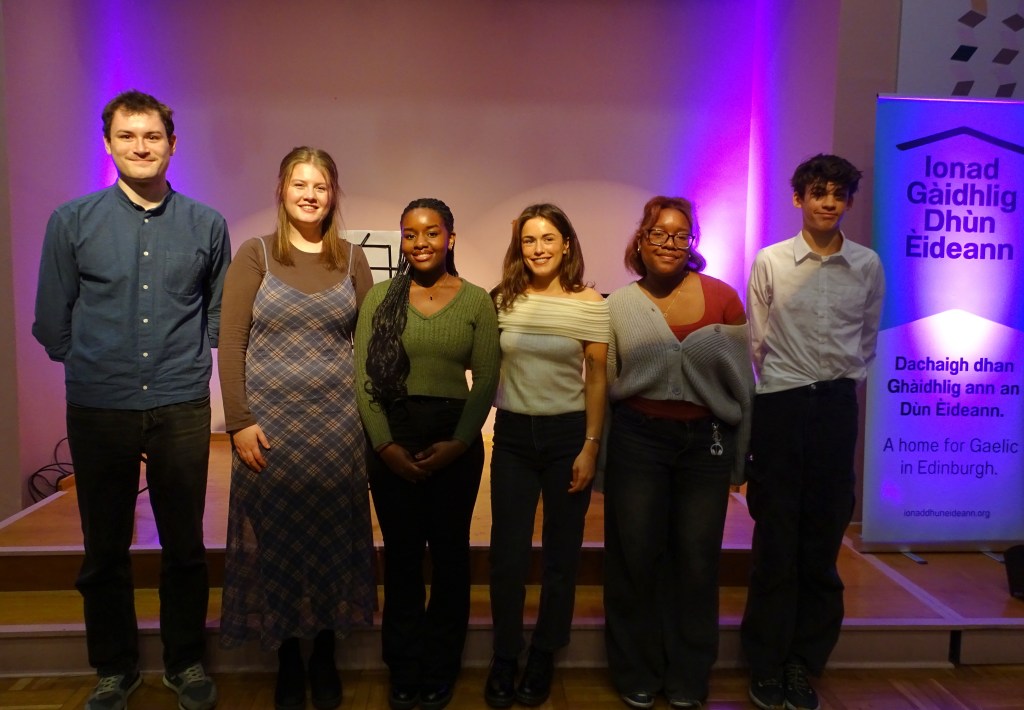
You can see snippets of the songs below with information about their background and the stories they convey.
Many, many thanks to these talented musicians, and also to the National Library of Scotland for hosting the event. We are also grateful to Maoin nan Ealan Gàidhlig which provided the funding which made it all happen.
This is the final event in a series looking at Gaelic and Edinburgh for the Edinburgh 900 celebrations and which coverered Gaelic place-names in the city, the Gaelic population of Edinburgh, Gaelic education and Gaelic writers and writing in and about the city. You can find out more about previous events here.

Òran do luchd-giùlain chathraichean an Dùn Èideann (Song to the Edinburgh Chairmen)
In 18th-century Edinburgh the equivalent of the taxi was the sedan chair, in which passengers were carried from place to place. The great majority of the chair carriers were Gaels, and this lively song by Raibeard Stiùbhard (Robert Stewart) praises their skill, vigour and expertise.
Performed by Tawana Maramba, Iris MacLeod, Laura Penman and Alasdair Scott.
Bothan Àirigh am Bràigh Raithneach (A Shieling Hut in Brae Rannoch)
For many Gaels Edinburgh was seen as the source of new fashions and luxuries. This anonymous song from Rannoch in Perthshire describes how a young woman in what we might call a ‘love nest’ waits for her lover to return with new ‘gear’ for her, including a special belt from Edinburgh.
Performed by Iris MacLeod and Laura Penman
Òran an t-Saighdeir (The Soldier’s Song)
Edinburgh was an important military centre through the centuries, especially at the Castle, and many Gaels joined the army. In this anonymous song, probably from the early nineteenth century, a young man describes being recruited by another Gael while he was walking in Edinburgh, but he now regrets his decision bitterly.
Performed by Seren and Tawana Maramba, and Laura Penman.
Moladh na Luinge (In Praise of the Ship)
There is a long tradition in Gaelic of songs in praise of boats and seafaring and this song by Coinneach MacCoinnich (Kenneth Mackenzie) at the end of the eighteenth century is an unusual example. The singer is down on his luck now and living in Edinburgh, but he recalls better days at sea, part of a strong and lively crew tackling the surge and the elements.
Arranged and performed by Laura Penman.
Ge Socrach Mo Leaba (Although My Bed is Comfortable)
This is the oldest Gaelic song composed in Edinburgh, dating from around 1680. The poet, Archibald Macdonald, known as An Ciaran Mabach or The Dusky Stammerer, came to Edinburgh to have surgery on his foot. He mentions Holyrood Abbey and Leith in the song but he longs to be back home, sleeping on the heather and hunting deer on the moors in Skye, Uist and Lewis.
Performed by Tawana Maramba and Laura Penman.
Òran anns a bheil am bàrd a’ moladh a leannain agus a dhùthaich fhèin (Song in which the bard praises his beloved and his homeland)
Uilleam Ros (William Ross) is perhaps the most famous love poet in Gaelic and in this song composed around 1780 he expresses love both for his beloved and his homeland (Skye and Ross-shire). But he is stuck in Edinburgh, surrounded by English speakers for whom he expresses disdain, hoping to return home soon.
Performed by Iris MacLeod and Laura Penman.
‘S gann gun dìrich mi chaoidh (I Will Scarcely Go)
As the capital city Edinburgh was the centre of law and authority in Scotland, and many Gaels perceived its power, sometimes resentfully. In this early nineteenth-century song from Skye, Tormod MacNeacail (Norman Nicolson) recounts how he received a lawyer’s letter from Edinburgh banning him from hunting and fishing in the deer-forest.
Performed by Tawana Maramba and Laura Penman.
An t-Sòbhrach Mhuileach (The Mull Primrose)
This song was composed by the Mull poet Dùghall MacPhàil (Douglas Macphail) in 1870. The poet received primroses as a gift from home and he planted them in his garden in Sciennes next to his lilies. He describes the primroses as being far away from home in the land of smoke and Lowlanders, a metaphor for the poet himself and other Gaels in the city.
Performed by Oisín Fuentes
Màili Dhonn (Brown-haired Mary)
As mentioned above, there is a long tradition in Gaelic of songs in praise of boats and here the boat is given a girl’s name (Màili Dhonn or Màiri Dhonn, meaning brown-haired Mary) and personified as a young woman. Edinburgh and Leith are mentioned among other places that she visits in Scotland and England.
Performed by Iris MacLeod, Laura Penman, Tawana Maramba, Seren Maramba and Oisín Fuentes.
 Ionad Gàidhlig Dhùn Èideann